In agricultural robotics, raising $100M is normal. Announcing a profitability date is not. Carbon Robotics raised $184M. Ecorobotix raised $186M. Verdant Robotics has funding rounds but no public break-even target. None of them have said when the business sustains itself.
Niqo Robotics raised $22M total. In March 2026, they announced they're on track for group-level profitability in FY 2026-27. No agricultural robotics company has publicly crossed that line. They're the first to claim the attempt.
Founded by Jaisimha Rao (Founder & CEO), a Carnegie Mellon engineer who spent seven years at BlackRock before returning to India and eventually building AI that teaches itself to see like a farmer.
This Week's Breakdown: Niqo Robotics
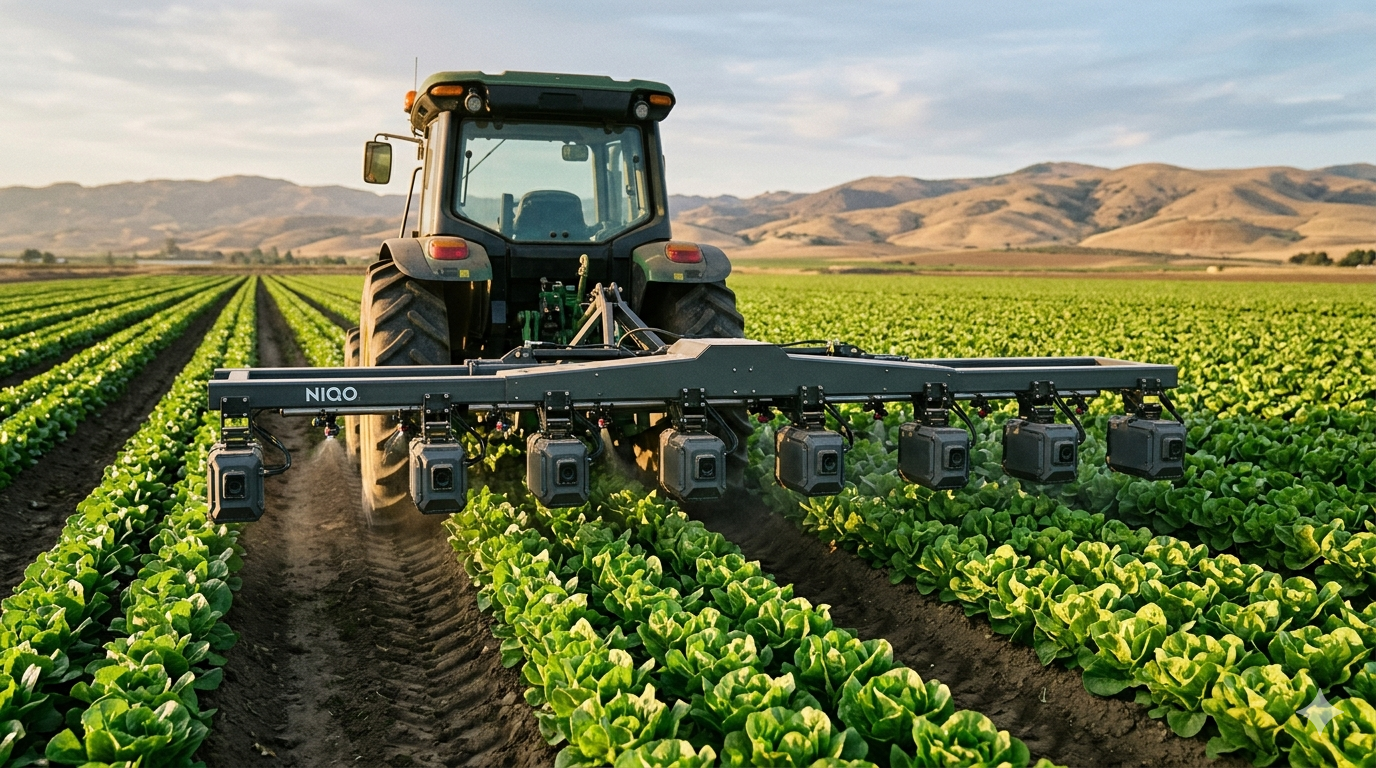
What they do: Niqo builds AI-powered precision agricultural robots that retrofit onto tractors farmers already own. Their core technology, Niqo Sense, is a proprietary camera system that identifies individual plants in real time — on-device, zero cloud required — and fires high-precision nozzles at weeds while sparing crops. The result: 50–90% reduction in agrochemical usage, 12–18 month ROI for American lettuce growers, and a business now operating across India and the U.S.
The numbers: $22.17M raised across five rounds (Seed 2019, Series A ~$5M 2021, Series B $13M April 2024). Investors: Blume Ventures, Omnivore, BEENEXT, FMC Corporation, Fulcrum Global Capital, Bidra Innovation Ventures. 82 employees. 50+ units in India, 11 in the U.S. (California, Arizona, Georgia). 180,000+ acres sprayed as of 2025. RoboWeeder: ~$350K. RoboThinner: ~$250K. Targeting group profitability in FY 2026-27.
How It Actually Works
A farmer drives their existing tractor across a lettuce field. Mounted on the back is Niqo's hardware frame, holding Niqo Sense: a custom-built camera running on a proprietary motherboard with a GPU, deep learning accelerator, and FPGA-based image processor. It scans at 30 frames per second. Every 100 milliseconds, it identifies each plant — crop or weed — and fires one of two precision nozzles. No cloud call. No internet required. Everything happens on the machine, in the field.
The hard problem was getting AI to see what a farmer sees. Plants look different at dawn versus midday. Young lettuce and young weeds are nearly identical at early growth stages. Shadows change contrast. Dust blurs edges. Niqo solved this the patient way: cameras mounted on wheelbarrows powered by car batteries, pushed through hundreds of acres of cotton and chili fields in Maharashtra, collecting training data across conditions no controlled lab could replicate.
That dataset is now the moat. Niqo Sense runs identical camera hardware and core software in India and the U.S. Only the mechanical frame and crop-specific AI models differ between products. Expanding into a new crop — onions, broccoli, tomatoes, turf grass — means shipping a new model library, not rebuilding hardware. One platform, many markets.
The Key Bets
| Decision | What they chose | What everyone else does |
|---|---|---|
| Hardware strategy | Retrofit AI onto the tractor the farmer already owns | Build fully autonomous, purpose-built robots from the ground up |
| India distribution | VLE (Village Level Entrepreneur) model: local agents lease machines, service farming communities at ₹300–500/acre | Sell hardware directly to farmers or use robotics-as-a-service subscriptions |
| U.S. pricing | One-time hardware purchase, no recurring software subscription | Competitors layer annual software fees on top of already high hardware costs |
The Real Story
Jaisimha Rao spent seven years at BlackRock managing assets on Wall Street. He was there through the 2008 financial crisis, watching one of the most complex systems in the world break down in real time. He later credited those years — the attention to detail, the discipline of showing up when things get complicated — with how he eventually built a hardware company.
In 2015, he visited his father's coffee farm outside Bangalore. He'd been a software and finance person his whole career. What he found there was an industry that hadn't changed much. Farmers were spraying entire fields uniformly, based on visual inspections and inherited wisdom. The lunar calendar drove pesticide timing. Every acre got the same chemical load regardless of what individual plants actually needed. For someone trained to spot inefficiency, the gaps were everywhere.
He started Tartan Sense in February 2015 with drone-based aerial imaging — farm maps, plant health data, yield forecasts. The technology worked. Projects came in from Indonesian palm plantations and Texas corn farms. But the next season, when the team tried to resell their analytics, farmers gave a consistent answer: if you can show me what's wrong with my field, I also want to take action on it. Data without action wasn't the product.
The second attempt was bolder: fully autonomous electric robots designed for India's fragmented small farms. Robot swarms communicating across fields to optimize coverage. Farmers loved the concept. The logistics collapsed it. Robots needed trucks to reach remote fields. Battery life ran five to six hours. Charging infrastructure didn't exist in rural Maharashtra. After two years of development running through COVID, the team abandoned the approach entirely.
The breakthrough came from a simple realization: don't fight the tractor. The tractor already gets to the field. It runs on diesel. It hauls implements. It is, in Rao's words, "a boss." Niqo pivoted in 2022 to building a retrofit implement that attached to whatever tractor a farmer already owned. The transport problem disappeared. The charging problem disappeared. The farmer's existing machine became the distribution vehicle. With logistics solved, the team could focus on what they were actually building: an AI system that sees and acts like a farmer would.
The Two-Country Playbook
Niqo doesn't advertise. The business grows differently on each continent.
In India, the key was recognizing that individual smallholders couldn't afford a $350K machine, and that no direct sales motion would reach millions of fragmented farms. The solution became the VLE model. Niqo leases machines to local entrepreneurs for ₹4.5 lakhs per season. Those entrepreneurs then offer spraying-as-a-service to their farming communities at ₹300–500 per acre — accessible to even small-scale farmers. VLEs typically net ₹9 lakhs annually after lease costs. Farmers reduce pesticide bills by 50–60%. The technology spreads the same way any trusted farm tool does: a neighbor saw it work, so they tried it.
The tactic that converted skeptics was simple: free two-acre trials. Yogesh Raut, a cotton and soybean farmer in Vyala, Akola, wouldn't consider the technology without seeing it on his own land. He followed the machine across his test plot, scrutinizing every plant it treated. By the end of the day, the savings were visible. He approved treatment for his entire field and became one of Niqo's most effective local ambassadors.
In the U.S., the model is nearly the inverse. American specialty crop farmers have the capital and established dealer relationships. Niqo sells through dealer networks in California's Salinas Valley and Arizona's Yuma region — the heart of U.S. lettuce production. The pitch is arithmetic: manual thinning runs $185–200 per acre. A RoboWeeder pays itself off in roughly 2,200 acres. On a 1,500-acre lettuce operation, the math closes in about a season and a half. U.S. manufacturing moved to domestic facilities for RoboWeeder (cameras still ship from India) — which reduces tariff exposure and, Rao notes, improves grower confidence.
How Niqo Makes Money
| Market | Model | Price Point |
|---|---|---|
| India (RoboSpray) | VLE seasonal lease | ₹4.5 lakhs/season to VLE; VLE charges ₹300–500/acre |
| U.S. (RoboWeeder) | Direct sale via dealer network | ~$350,000 one-time |
| U.S. (RoboThinner) | Direct sale via dealer network | ~$250,000 one-time |
| Maintenance (all markets) | Optional package | Covers cameras and in-cab display; no software subscription |
No per-seat fees. No recurring software license. When a U.S. farmer buys a Niqo machine, they own it. Algorithm updates are included.
Verdant Robotics, Niqo's closest U.S. competitor, charges ~$350K hardware plus annual subscription fees. Niqo's view: farmers think in terms of capital equipment — tractors, combines, implements. A single capital number they can depreciate is easier to justify than a perpetual invoice.
A third revenue stream is in development: major agricultural equipment manufacturers have approached Niqo about embedding Niqo Sense into their products. An OEM deal would let Niqo's AI camera move from 60 deployed units to whatever volume a manufacturer ships in a single season.
The Global Landscape: Precision Ag Robotics
Autonomous weeding and precision spray robots raised more than $180M in 2025 — roughly 27% of all precision agricultural capital tracked globally, per iGrow Intelligence. Commercial scale in the U.S. and Europe is projected by end-2026 for a small number of leading companies.
The Big Players
| Company | HQ | Funding | Revenue | What They Do |
|---|---|---|---|---|
| Carbon Robotics | Seattle, USA | $184M raised | $100M+ (FY ending Jan 2026); 15 countries | LaserWeeder: kills weeds with lasers, no chemicals; also autonomous tractor kit |
| Ecorobotix | Switzerland | $186M+ ($106M Series D, Oct 2025) | Generating revenue | AVO robot: AI-guided micro-spraying at ultra-low herbicide doses; European focus |
| John Deere See & Spray | USA | Public ($54B revenue) | Product line, not disclosed | Broad-acre crops (corn, soy); AI vision for commodity-scale farms |
The Mid Players
| Company | HQ | Funding / Status | What They Do |
|---|---|---|---|
| Verdant Robotics | USA | VC-backed | SharpShooter AI precision spray; ~$20M cumulative sales; $350K + annual subscription |
| Naïo Technologies | France | PE-backed | Autonomous weeding robots for European row crops; early mover in the category |
| FarmWise | USA | Acquired by Taylor Farms (2025) | Leafy green weeder; brought in-house by a large produce operation |
| TRIC Robotics | USA | $5.5M Seed (2025) | Precision weeder, early stage |
The Small Players
| Company | HQ | Funding | What They Do |
|---|---|---|---|
| Niqo Robotics | India / USA | $22.17M | Tractor-retrofit AI; dual India/U.S. markets; closest to profitability |
| Bonsai Robotics | USA | $15M Series A (2025) | Vision-based autonomous harvest and weeding |
| Aigen | USA | VC-backed | Solar-powered autonomous weeder for large-scale row crops |
Niqo is a small player by funding. On capital efficiency and path to break-even, they're ahead of everyone in the space who has been public about it. The big players collectively raised more in a single round than Niqo's total.
How We Got Here
| Year | What Happened | Key Event |
|---|---|---|
| 2015 | Jaisimha Rao founds Tartan Sense | Drone-based aerial imaging for farms; bootstrapped |
| 2018 | Pivot to land-based robots | Farmers want action, not just data analytics |
| 2019 | Seed funding raised | First outside capital after four years bootstrapped |
| 2020–21 | Autonomous robot attempt | Electric swarm robots fail on logistics and charging during COVID |
| Mar 2021 | Series A (~$5M) | Blume Ventures, Bidra, others |
| 2022 | Rebrands as Niqo Robotics | Third pivot: retrofit implement replaces autonomous robot; Niqo Sense finalized |
| 2023 | Launches RoboSpray fleet in India | 50 units; 90,000+ acres treated in first commercial year |
| Apr 2024 | Series B: $13M | FMC Corporation (strategic), Fulcrum, Omnivore |
| 2024 | 100,000 acres sprayed; RoboThinner launches | U.S. expansion begins |
| 2025 | 180,000+ acres sprayed; RoboWeeder enters U.S. | 11 units in California, Arizona, Georgia |
| Mar 2026 | Profitability announcement | Core business on track for group-level profitability FY 2026-27 |
The Pattern You Can Steal
1. Work with the infrastructure your customer already has. Niqo's two failed iterations tried to replace or bypass existing farm equipment. The successful one attached to it. The farmer already owns a tractor, knows how to operate it, and has diesel. When your product becomes an attachment instead of a replacement, adoption friction collapses. Look at what your customers use every day and ask whether your product could bolt onto that instead of competing with it.
2. Build one technical core, serve multiple markets. Niqo's Indian RoboSpray and U.S. RoboWeeder share identical camera hardware and core software. Only the frame and crop models change. This is what makes expanding into onions, tomatoes, and turf grass feasible without full rebuilds. If you're designing for one market, ask whether the core technology could serve a second one by changing the layer closest to the customer, not the layer closest to the engineering.
3. Let price-sensitive markets fund your data advantage. India couldn't support a $350K machine, so Niqo invented the VLE model at ₹300/acre. That constraint forced a distribution model that gave them hundreds of thousands of acres of real-world training data across diverse growing conditions — which made the AI better — which made the U.S. product credible when they arrived. Emerging market price ceilings built a moat that premium markets later paid for.
Quick Hits
Carbon Robotics crossed $100M in annual revenue for the fiscal year ending January 2026 — the first agricultural robotics company to publicly hit that mark. They're now launching a next-generation "AI robot" and operating in 15 countries. Business Wire
Ecorobotix closed a $106M Series D in October 2025 — the largest single precision ag robotics round ever recorded globally. Swiss company, European focus, AI-guided micro-spraying that applies herbicide to individual plants at doses far below conventional broadcast rates. Precision Farming Dealer
FarmWise was acquired by Taylor Farms in 2025, one of North America's largest fresh produce companies. Buying the robot maker instead of renting it signals how large-scale specialty crop operations expect to account for this technology in their long-term cost structure. Precision Farming Dealer
What We're Watching
Profitability as the new benchmark. In a space where peers raised hundreds of millions without announcing a break-even date, Niqo's FY 2026-27 target changes the conversation. If they hit it, every other ag robotics company faces the same question from investors and farmers: when do your unit economics close?
The OEM path. If Niqo closes a deal to embed Niqo Sense into a major manufacturer's product line, the business changes its nature overnight. Instead of selling 60 units per year through dealer networks, they license the AI camera into the supply chain of companies that sell tens of thousands of implements annually. The risk is an OEM building competing vision in-house and cutting Niqo out. The upside is asymmetric.
New crops as new markets. Expanding into onions, tomatoes, broccoli, kale, and turf grass in the Pacific Northwest isn't a product update. Each crop is a new addressable market. Niqo's structural advantage is updating a model library rather than rebuilding hardware. How fast they can ship new crop configurations will determine whether the platform approach compounds or stalls.
Ship it.
— The FounderSpec Team