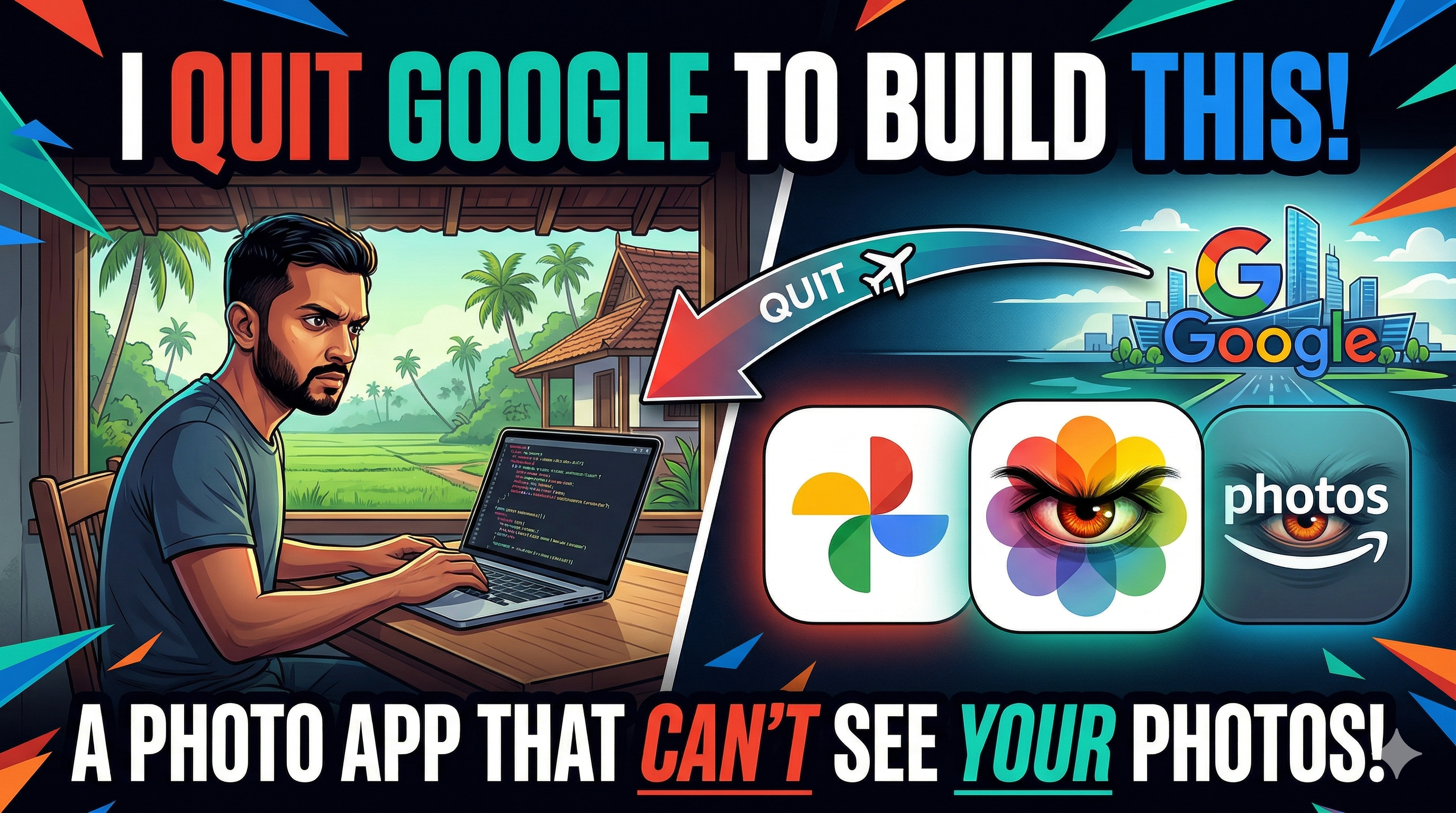
Google Photos is scanning your memories. Apple can access yours unless you know to turn on Advanced Data Protection. Amazon Prime's "free unlimited photo storage" is paying for itself in ways you probably haven't thought about.
Vishnu Mohandas thought about it. He was inside Google when he figured out just how little the company cared about user privacy. So he quit, flew back to Kerala, wrote the first line of code on February 1st, 2020, and started building a photo app that technically cannot see your photos.
Founded by Vishnu Mohandas (Founder & CEO) and Neeraj (Engineering Lead, early co-builder).
This Week's Breakdown: Ente
What they do: Ente is an open-source, end-to-end encrypted cloud storage platform for photos. Their flagship product, Ente Photos, backs up your entire library across iOS, Android, desktop, and web without the service ever being able to decrypt or view your files. Face recognition, natural language search, curated memories: all of it runs on your device. A second product, Ente Auth, provides free encrypted 2FA token backup.
The numbers: 150,000+ registered customers. 165 million+ photos backed up. 25,600+ GitHub stars. 290 contributors. 12 full-time employees. $0 raised. Bootstrapped entirely by customer subscriptions. Recommended by CERN, Linus Tech Tips, and Zerodha.
How They Built It
| Layer | Choice | Why |
|---|---|---|
| Mobile frontend | Flutter (Dart) | Single codebase for iOS, Android; 48% of the repo is Dart |
| Web / desktop | TypeScript | All web and desktop clients; 27% of the repo |
| Backend server ("Museum") | Go | Statically compiled single binary; simple to self-host |
| AI/ML | On-device CLIP (GGML) + Rust via Flutter Rust Bridge | Zero-knowledge constraint forces all AI to run locally; Rust drops similarity search from 30 min to 30 sec on 50k photos |
| Vector DB | USearch (open-source, HNSW, written in Rust) | Integrated into mobile clients for on-device semantic search |
| Database | PostgreSQL | Server-side metadata and account management only; no photo content |
| Cryptography | XChaCha20, XSalsa20, Poly1305 (libsodium) | Audited by Cure53, Symbolic Software, and Fallible |
| Hosting/Infra | Multi-cloud EU: Amsterdam, Paris (underground facility), Frankfurt | Three providers, three countries; one in an underground bunker |
| Storage | S3-compatible (self-hosted: MinIO or Garage; cloud: external buckets) | Lets users self-host on their own object storage if they choose |
Stack confirmed from the ente-io/ente GitHub monorepo, engineering blog posts on Rust and vector DB integration, self-hosting documentation, and Cure53 audit reports.
The Real Story
Vishnu Mohandas grew up in Kerala. He studied computer science at BIT Mesra, worked at Directi and Zeta, and eventually landed at Google in Zurich working on Google Assistant's serving infrastructure. By his own account, the months inside Google suffocated him.
It wasn't about the engineering. It was about watching a company that took security seriously but treated privacy as an afterthought. "They don't really care about customer data or what implications can come from being careless about it," Mohandas told TechCrunch in 2025. "In hindsight, this is not surprising because they are an advertisement company."
He tried Apple. Hated the ecosystem lock-in. Tried Dropbox. Found it clunky across devices. No existing product did what he needed, so he decided to build it himself. Google's lawyers noted the project was in "direct competition." Given that Google competes with everything, this wasn't particularly surprising, but it pushed Mohandas to move faster.
On January 31st, 2020, he badged out of the Zurich office for the last time, shipped his belongings, and flew home. The next morning, he wrote the first line of Ente. COVID hit a few weeks later. He was home in Kerala, working around the clock on a privacy photo app, while his parents quietly wondered what had gone wrong with their son who'd been doing so well in Switzerland.
The early days were not easy. Neeraj, an engineer with stints at Uber, Flock, and Sumo Logic, joined early and became the technical backbone of the product. Vishnu has been direct about the debt: "He had joined the cause assuming that given my delusion I'd solve for capital along the way, but instead, we had to cut down on lifestyles Big Tech had gotten our families used to."
No VC came. Vishnu didn't want VC. His reasoning was specific: the cost of shutting down a privacy storage company is unusually high. Customers trust you with photos they can't easily move. Chasing growth at the expense of sustainability would be a different kind of violation of that trust.
So they grew slowly, on subscriptions. They published the full server code. They ran security audits and published the results. They added storage locations until three copies of your data sat in three different EU data centers, including one in an underground facility in Paris that felt almost theatrical in its commitment.
By the time TechCrunch covered Ente in April 2025, the product had 150,000 registered customers. None of them had been acquired with paid ads. All 12 employees had joined from the open-source community.
The Marketing Playbook: Trust as Distribution
Ente spent nothing on paid acquisition. The marketing strategy was the product's transparency.
The open-source monorepo includes the full server. Anyone can read every line of code that handles their photos. That's rare. Most "privacy-focused" companies are black boxes with a blog post claiming they care about privacy. Ente's claim is verifiable.
Three independent security firms audited the cryptography and published their findings. Cure53's audit was sponsored by CERN. When CERN recommends your photo app, you put that on your website.
A self-hosting option exists. You can run your own Ente server on Docker with a few commands. Most users don't. But the fact that it's possible tells you something about the product's intent. Skeptical users who self-host for six months often switch to the paid hosted plan because it's easier and they've already decided the company is trustworthy.
The pricing decision reinforced the trust signal. Ente launched without a free plan. Not as a mistake, but deliberately. They wanted the business to be sustainable before they made it accessible. Only after the subscription base proved the model could survive did they introduce 5GB free storage. Vishnu wrote about this explicitly: "We knew this model would get in the way of widespread adoption, but we wanted to thwart existential risks."
The result is a company that grew to 150,000 customers almost entirely through word of mouth on privacy-focused subreddits, Hacker News threads, and F-Droid listings.
How Ente Makes Money
| Plan | Price/month | Storage | Notes |
|---|---|---|---|
| Free | $0 | 5GB | Account must be active once/year |
| Starter | $2.99 | 50GB | Annual billing available |
| 1TB | $9.99 | 1TB | Confirmed pricing; family sharing included |
| Higher tiers | Custom | Multi-TB | Up to 5 family members on any paid plan, no extra cost |
Storage is deduplicated server-side: identical files across albums are stored once, counting against your quota once. Referrals earn 10GB per friend.
The Global Market: Privacy Photo Storage
The photo storage market is estimated at $1.5B to $5B depending on methodology. Google Photos is the dominant player globally. Apple dominates on iPhone. Amazon has unlimited storage for Prime members.
The opportunity for everyone else opened on November 11th, 2020. That's when Google announced it was ending unlimited free photo storage. The backlash was immediate and large. It's also almost certainly the single event most responsible for Ente's eventual traction, even though Ente was already building before the announcement.
The Big Players
| Company | Scale | Notes |
|---|---|---|
| Google Photos | Billions of users | No E2EE; server-side encryption only; ad company at core |
| Apple iCloud Photos | 1.5B+ devices | E2EE available only if Advanced Data Protection is manually enabled |
| Amazon Photos | Free unlimited for Prime members | Server-side encryption; no E2EE |
The Mid Players
| Company | Revenue | Funding | Notes |
|---|---|---|---|
| Proton Drive (photos) | Not disclosed | ~$2M+ (EU grants, small rounds) | Swiss; added photo Albums in 2025; still primarily known for email |
| Internxt | $3.54M (2024) | $10.71M total | Valencia, Spain; zero-knowledge encryption; cloud storage broadly, not photos-first; 21 employees |
The Small Players
| Company | Notes |
|---|---|
| Ente | 150,000+ customers; bootstrapped; E2EE photos-first; fully open-source including server |
| Stingle Photos | Open-source, E2EE gallery app; 1GB free; very small; no notable funding |
| Immich | Self-hosted only; not a cloud service; massive open-source community; fills a different need |
Where Ente Sits
Ente is the only company in this list that is photos-first, fully open-source, bootstrapped, and commercially viable. Proton has more resources but photos is a secondary product for them. Internxt has more funding but is a generalist cloud storage company.
The moat isn't technical. Stingle exists. Immich is popular. The moat is the combination of a polished consumer product, a sustainable commercial model, and five years of demonstrated trustworthiness. Privacy is a market where reputation compounds slowly and decays fast.
How We Got Here: Ente's Timeline
| Year | What Happened | Key Event |
|---|---|---|
| 2019 | Vishnu decides to build while still at Google in Zurich | Google's lawyers flag it as competitive |
| Feb 1, 2020 | First line of Ente code written | Vishnu's last day at Google was January 31st |
| 2020 | Neeraj joins as founding engineer | Technical co-builder; former Uber, Flock, Sumo Logic |
| Nov 2020 | Google ends unlimited Photos storage | Opens the privacy storage market for alternatives |
| 2021 | Ente launches commercially with paid-only plans | No free tier by design; builds for sustainability first |
| 2022 | Cryptography audit by Cure53 | Sponsored by CERN; results published publicly |
| 2023 | Open-source server ("Museum") published | Full monorepo now public; completes transition to full open source |
| 2023 | Rust integrated via Flutter Rust Bridge | On-device similarity search drops from 30 min to 30 sec |
| 2024 | Ente Auth reaches widespread adoption | Free 2FA backup app; recommended by CERN, Linus Tech Tips, Zerodha |
| Early 2025 | 5GB free plan introduced | Added only after business reached financial sustainability |
| Apr 2025 | TechCrunch profile published | 150,000 customers, 165M+ photos backed up, 12 employees, $0 raised |
| 2025-26 | Ente Locker, Ente Paste, Ensu launched | Expanding encrypted storage platform beyond photos |
The Pattern You Can Steal
1. Prove sustainability before pursuing growth. Ente launched with paid-only plans and added a free tier only after the business was financially stable. The opposite sequence, free to build users, then scramble for revenue, produces companies that compromise on their core promise when the pressure hits. Vishnu was explicit: he didn't want to end up in a position where growth pressure forced decisions that hurt the people who trusted him with their photos.
2. Make your trust claims verifiable. In any market where trust is the product, saying you're trustworthy is worth less than proving it. Ente published the server code. Commissioned external audits and published the results. Made self-hosting possible. These aren't marketing tactics. They're commitments that constrain what Ente can do. Customers recognize the difference.
3. Open source your server to shrink your sales cycle. The technical buyer who evaluates privacy software wants to verify claims, not believe them. Putting the full server code on GitHub means no sales call required for that part of the decision. The product answers the trust question before a human has to.
Quick Hits
Immich has become the go-to self-hosted Google Photos replacement with 60,000+ GitHub stars. Not an Ente competitor, but evidence that the appetite for private photo storage goes deep when you give people control. GitHub →
Proton added photo Albums to Proton Drive in spring 2025, finally making it viable as a Google Photos alternative. With 100M+ users across Proton's suite, they have distribution that Ente doesn't. The question is whether photos is a priority product for them or a checkbox. Read more →
Google Photos now shows ads to free users in some regions. The policy shift is slow and quiet, but it signals the direction. Every step Google takes toward monetizing the photo library is a step that sends privacy-conscious users somewhere else.
What We're Watching
The product expansion is a real bet. Ente Locker, Ente Paste, and Ensu (a private local LLM app) suggest Vishnu is building toward an encrypted storage platform, not just a photo app. Whether the community trusts Ente with documents and notes the way it trusts them with photos remains to be seen. The brand does a lot of work here.
Self-hosting as a conversion funnel. Ente's self-hosting option is unusual: it builds trust with the most skeptical segment of the market and creates a path to paid plans for users who want the convenience without running their own infrastructure. More consumer privacy products should think about self-hosting as a marketing channel, not a support burden.
The bootstrapped constraint is also a moat. Ente can't take VC money and chase growth without undermining the premise of the company. Vishnu has said this explicitly. That constraint forces discipline that most funded competitors don't have. It also means Ente's incentive structure stays aligned with users rather than investors. In a category built on trust, that matters more than it does in most markets.
Ship it.
— The FounderSpec Team